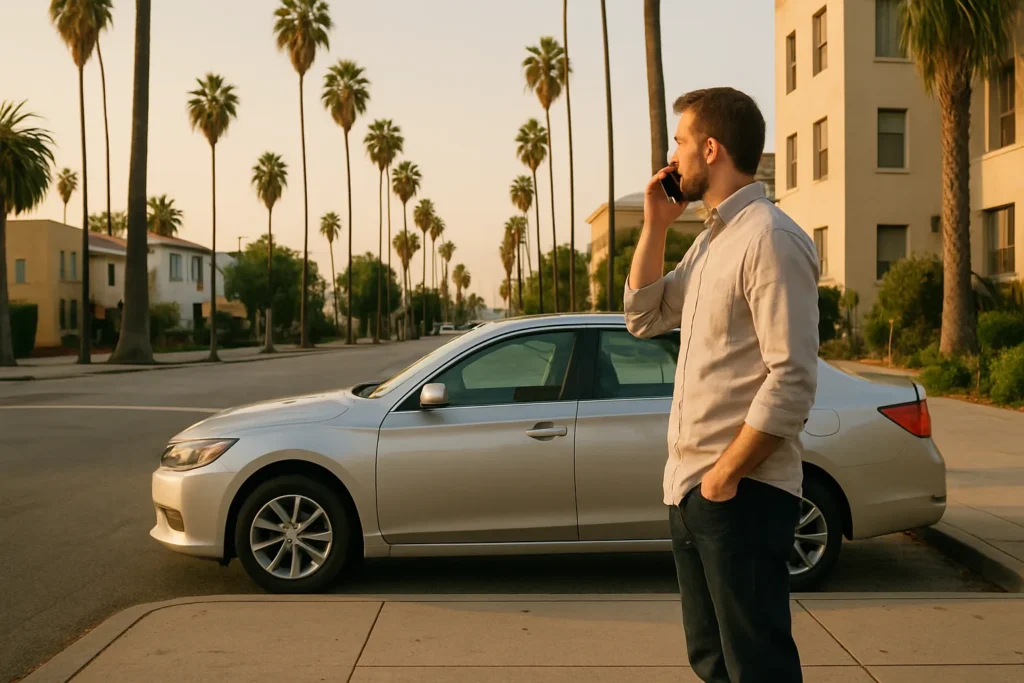







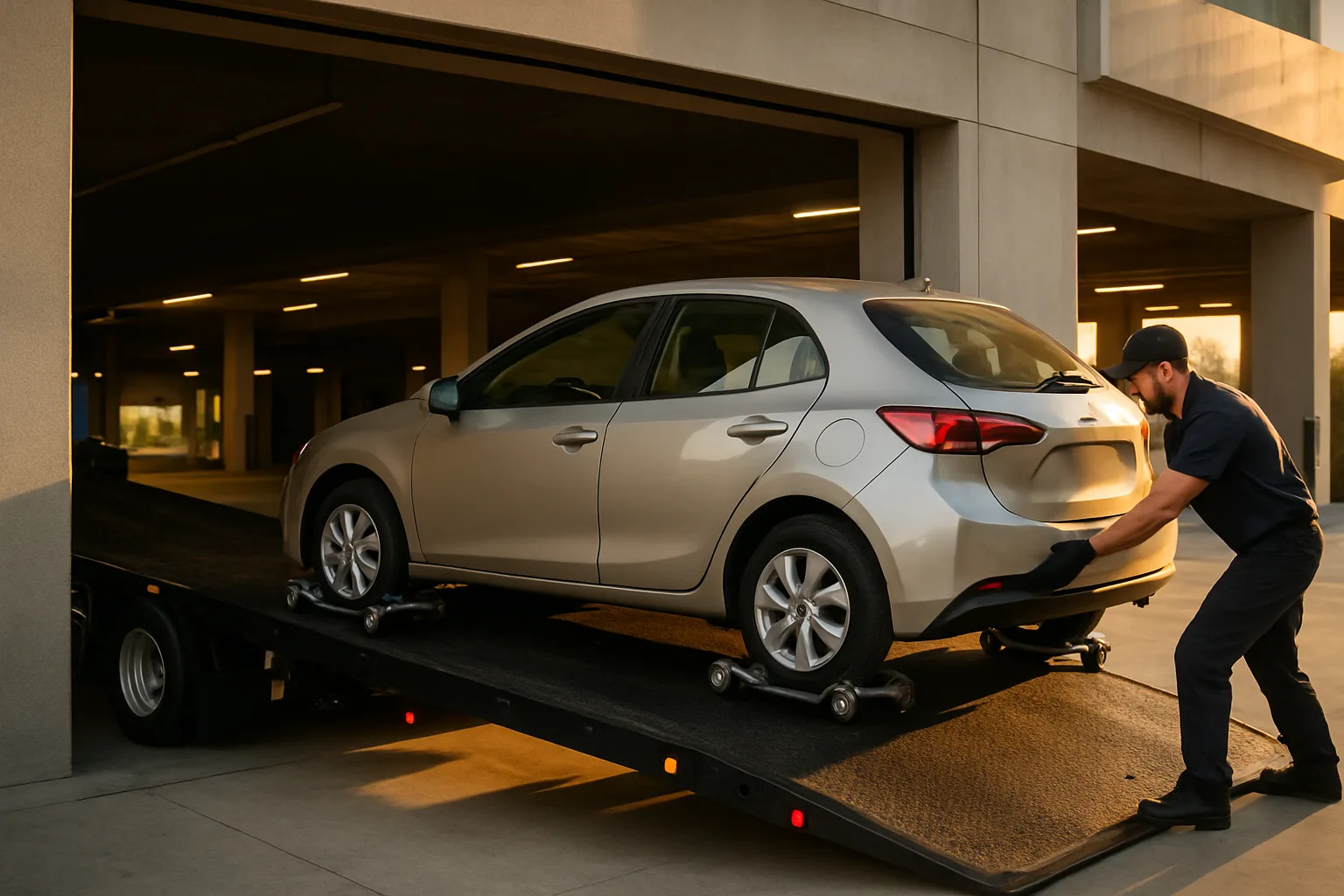
A car can often be moved when the parking brake is on, but it should not simply be dragged with locked wheels. The correct method depends on which wheels are locked, whether the brake will release, the vehicle’s drivetrain, its location, and the equipment available.
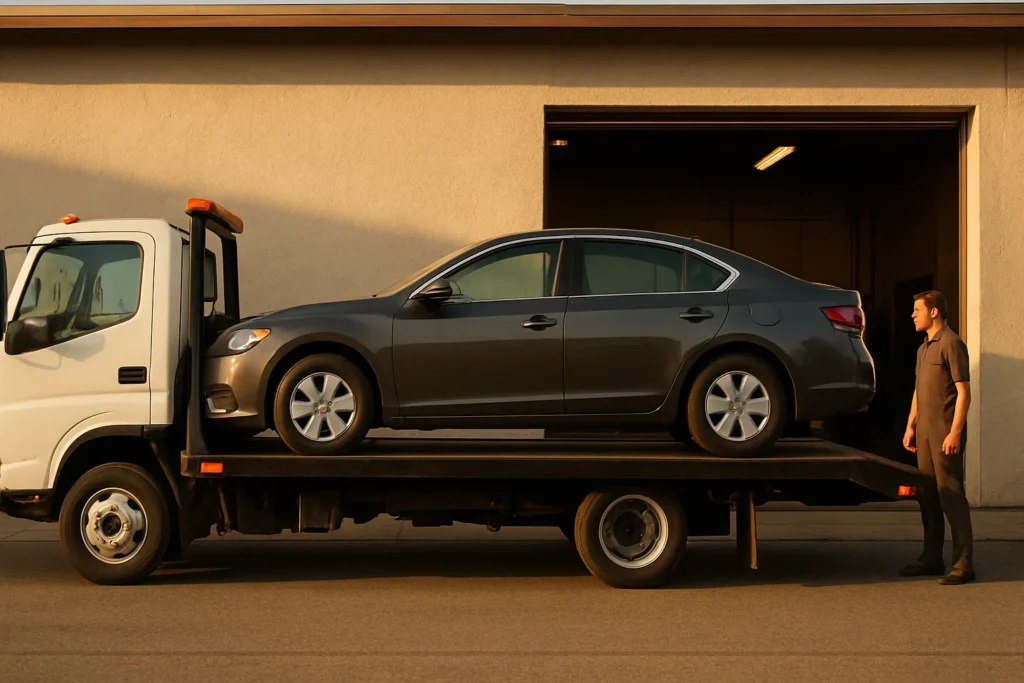
A flatbed is often appropriate because the entire vehicle rides off the road; the loading method still needs to suit the vehicle and its condition. Even then, the operator must load the car without grinding stationary tires across pavement or forcing components that are holding the vehicle in place.
What the Parking Brake Actually Locks
Most parking brakes act on the rear wheels, although designs vary. A traditional hand lever or foot pedal usually pulls cables connected to the brake mechanism. Many newer vehicles use an electronic parking brake controlled by a switch, motors, and the vehicle’s electrical system.
If the battery is dead, an electronic brake may remain applied. Collision damage, a broken cable, corrosion, a failed actuator, or a control-system fault can also keep a parking brake from releasing. Shifting the transmission into Neutral does not automatically release the parking brake.
Parking brake versus Park
The parking brake and the transmission’s Park position are separate systems. Park uses a transmission component to resist movement, while the parking brake holds at the wheels. A vehicle may have one, both, or neither successfully released. Tell dispatch exactly what the shifter and brake controls are doing instead of assuming the problem is only one system.
Why a Flatbed Helps
With flatbed towing, all four wheels are carried on the deck during transport. That prevents the locked wheels from rolling on the street and avoids the drivetrain concerns that can come with leaving driven wheels on the ground.
The difficult part is getting the vehicle onto the bed. Operators may use a winch with wheel skates, dollies, low-friction equipment, or another controlled loading technique. The goal is to reduce tire scrub and avoid forcing the brake, suspension, steering, or drivetrain.
Wheel skates and dollies
Wheel skates fit under tires so a locked wheel can slide in a controlled way during loading. Dollies can lift wheels off the surface. The operator chooses tools based on vehicle weight, available clearance, pavement, wheel position, and how much room the truck has to align.
Do not improvise with household jacks, loose boards, soap, oil, or another lubricant. Unstable supports can shift suddenly, and slippery material can create hazards for people and traffic.
When the Wheels Need to Roll
Some towing setups require one axle to roll on the road. A wheel-lift truck raises one end of the car, leaving the other wheels down unless dollies are used. Those road-contact wheels must be able to rotate without violating the manufacturer’s towing instructions.
Wheel movement may also be needed to position a car in a tight garage, straighten it for loading, or move it away from an obstacle. If the required wheels are locked, the operator must change the setup or use equipment that supports them. Our flatbed versus wheel-lift guide explains why access and vehicle design affect that choice.
Drivetrain Still Matters
Front-wheel drive, rear-wheel drive, AWD, and 4WD vehicles do not share one towing procedure. A released parking brake does not mean every drivetrain can safely roll with two wheels on the road. Manufacturer instructions and the vehicle’s actual condition control the method.
AWD and 4WD systems deserve special care because rotating one axle can affect connected components. Read our AWD and 4WD towing guide, and give dispatch the exact model and drivetrain before the truck is assigned.
Common Los Angeles Access Problems
Parking-brake calls are often complicated by location. Downtown Los Angeles and Koreatown garages may have low ceilings and tight turns. Hollywood Hills driveways can be steep and narrow. Apartment parking in Burbank or the San Fernando Valley may put the disabled car behind another vehicle or against a wall.
Send clear photos only from a safe position. Include the front and rear of the car, wheel angle, driveway slope, garage clearance sign, gate, and the path a truck would use. Check the Greater Los Angeles service area when describing the pickup neighborhood.
What to Tell Dispatch
State whether the parking brake is manual or electronic and what happens when you try to release it. Say whether the dashboard powers on, the engine starts, the shifter moves, the steering unlocks, and each wheel appears intact. Mention flat tires, damaged suspension, missing keys, blocked access, low clearance, and the planned destination.
Do not repeatedly force a stuck lever, pedal, electronic switch, or shifter. If the vehicle is exposed to traffic or cannot be positioned safely, request emergency towing and follow scene instructions while help is arranged.
Arrange the Right Towing Setup
Maps Towing serves Greater Los Angeles with offices in Van Nuys and Burbank. Explain that the parking brake is on or stuck before the truck is dispatched so the operator can plan the loading method and equipment. For assistance, Call (818) 797-1560.
Share: