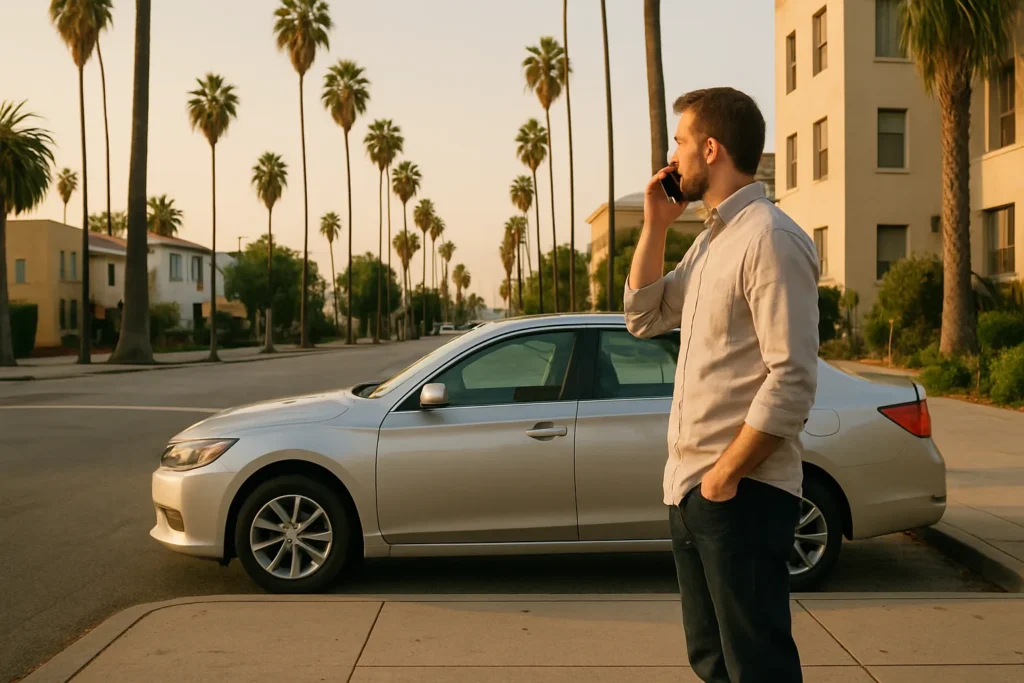







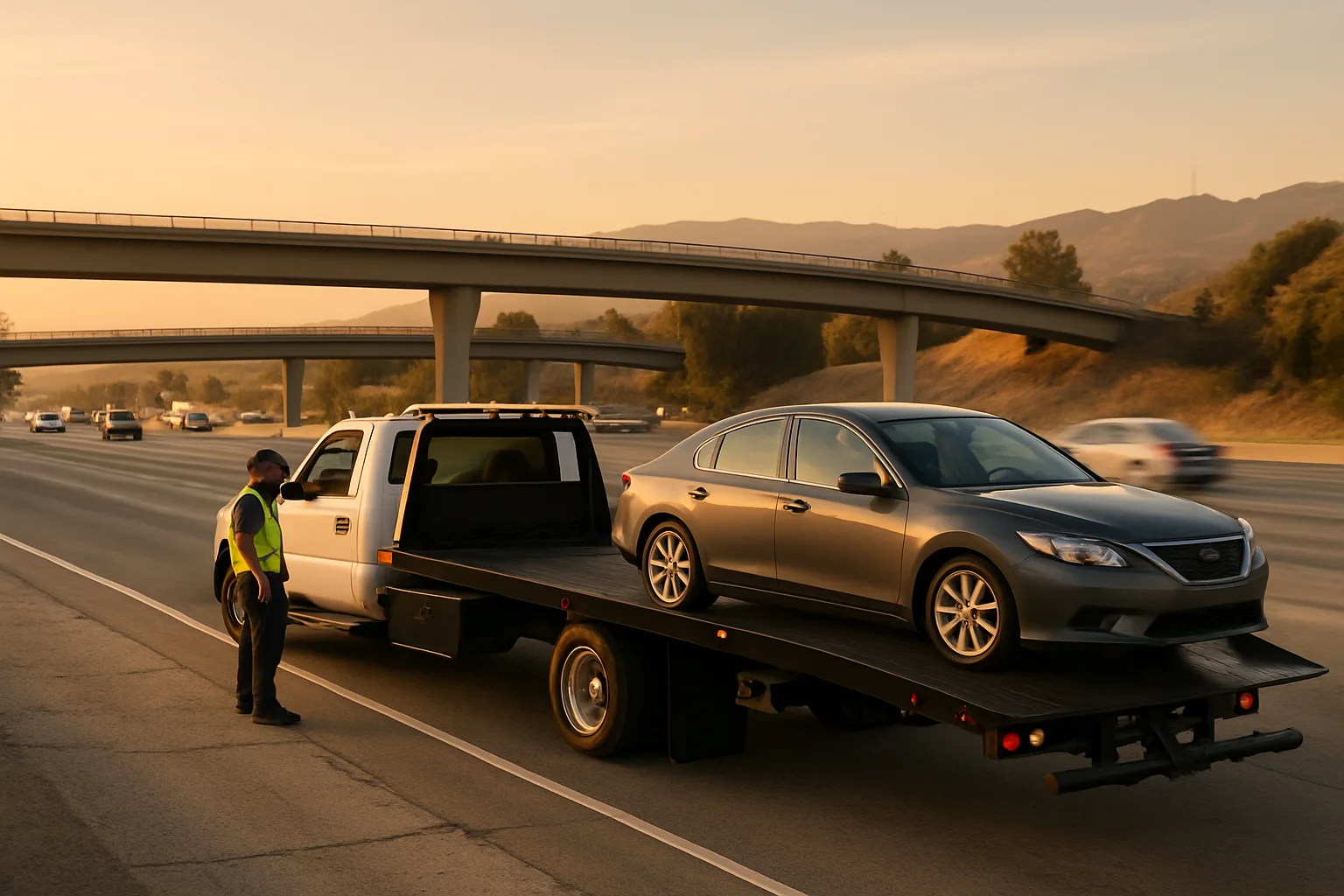
A breakdown on the 101, 405, or 134 demands quick decisions because traffic speed, shoulder width, and interchange geometry can change within a short distance. The basic priorities are always the same: leave the active lane if the vehicle can move safely, make the car visible, share an exact location, and keep people away from traffic.
The details you give dispatch matter on these routes. “On the 405” is not enough to identify which side of the freeway can reach you. Direction, nearest exit, and position relative to an interchange help a tow operator approach without a risky last-second maneuver.
First Actions on Any Los Angeles Freeway
Turn on the hazard lights as soon as the vehicle begins losing power, overheating, or handling abnormally. Signal and move toward the right shoulder or a safer paved area while steering and momentum remain available. Stop as far from moving traffic as conditions allow, set the parking brake, and keep the wheels turned away from the traffic lane when practical.
If the vehicle stops in a live lane, remain belted, call 911, and state the lane, route, and direction. Do not try to push a car through freeway traffic. If there is smoke, fire, leaking fuel, or another immediate danger, follow emergency-dispatch instructions and exit only by the route farthest from moving vehicles.
The general freeway breakdown safety guide covers visibility, passenger safety, and when a roadside repair is too exposed to attempt.
Breaking Down on the 101
Identify the segment and direction
The 101 runs through Hollywood and the San Fernando Valley before continuing west. In the Valley, it connects neighborhoods including Studio City, Sherman Oaks, Encino, and Woodland Hills. Near the 405 interchange, ramps and collector lanes can make a location pin appear close while placing the vehicle on a different approach.
Tell dispatch whether you are traveling northbound, southbound, eastbound, or westbound as shown by the signs where you entered, then provide the nearest named exit. Say whether you are before or after the exit and whether you are on the main roadway, a transition ramp, or an on-ramp shoulder. Drivers near the central Valley can use the Van Nuys service-area page for nearby coverage context.
Breaking Down on the 405
Sepulveda Pass and Valley access
The 405 crosses the Sepulveda Pass and continues through the western side of the Valley. Grades, heavy traffic, and limited shoulders can turn an ordinary mechanical problem into a dangerous stop. If the temperature gauge rises or warning lights appear on a grade, reduce strain and move toward a safe exit or shoulder before the car loses power.
On the pass, a dispatcher needs the travel direction, nearest exit, and a clear description of the shoulder. Do not stand beside the traffic-facing side of the car. A jump start or tire change that would be routine in a parking lot may be unsafe there; emergency towing may be the appropriate way to move the vehicle to a protected location.
Breaking Down on the 134
Burbank, Glendale, and Pasadena approaches
The 134 runs east-west through the Burbank and Glendale corridor toward Pasadena. Interchanges near the 5 and 2 can complicate access, especially when a vehicle is stopped on a transition ramp. Specify the route you are leaving, the route you are joining, and the direction of the ramp.
For a stop near the eastern Valley, consult the Burbank towing area or Glendale towing area. Those pages help confirm local coverage, but the exact freeway side still needs to be shared with dispatch.
Give Dispatch a Location That Can Be Reached
Open your map application and drop a pin, then check whether it lands on the correct carriageway. Read the freeway number, direction, nearest exit, and any visible call-box or bridge information. If you moved to an off-ramp, name the surface street at the bottom of the ramp. Keep the phone charged and audible so the operator can confirm the final approach.
Also describe the vehicle and condition: year, make, model, drivetrain, warning lights, tire or wheel damage, and whether the transmission shifts to neutral. Mention passengers, pets, low ground clearance, or collision damage so the truck arrives prepared.
Prepare for Loading and the Drop-Off
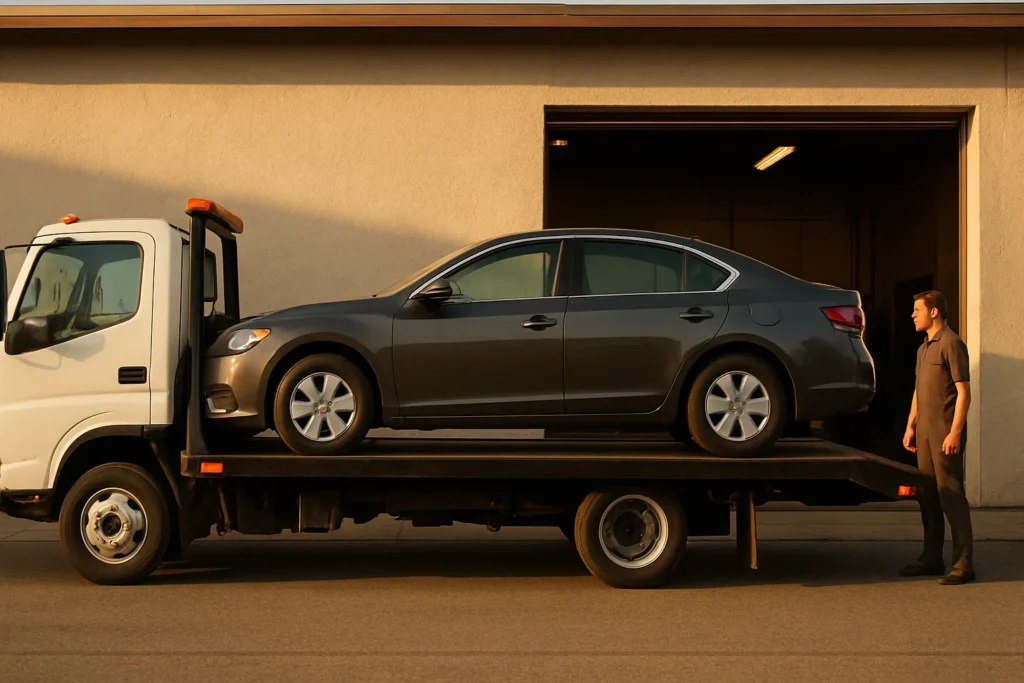
Choose a repair facility, home, body shop, or other destination before the operator arrives. Confirm that the location is open or has an after-hours process, and decide who will receive the keys. Remove medication, identification, electronics, garage remotes, and other essentials while you remain in a protected position.
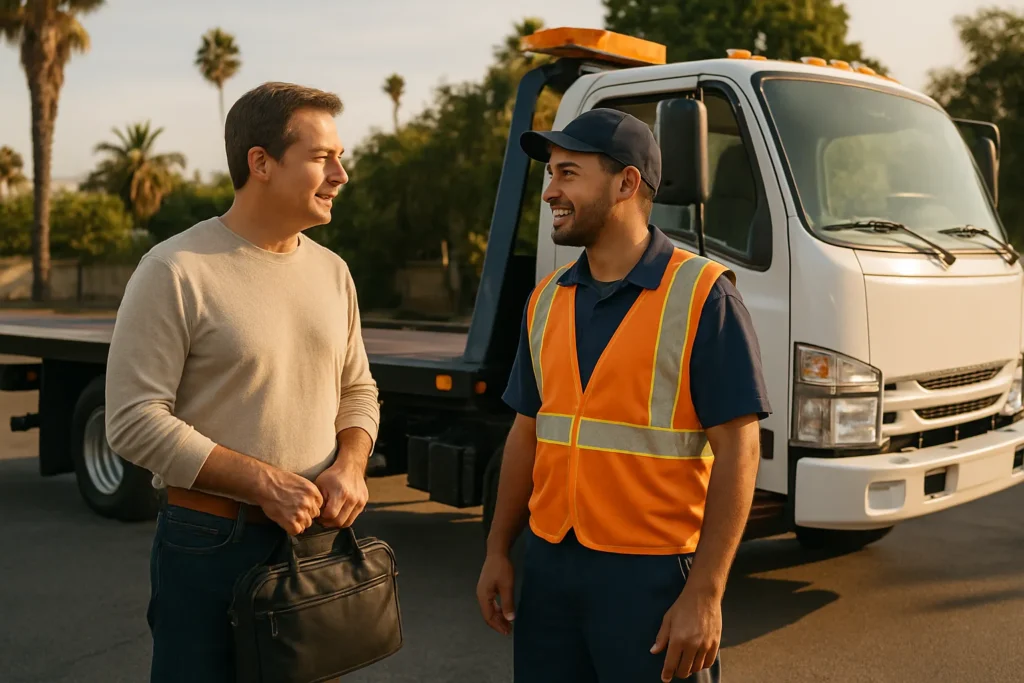
When the truck reaches the scene, wait for the operator to tell you where to stand. Do not walk between the truck and vehicle or handle a winch cable. Freeway loading may require coordination with law enforcement or freeway personnel, and the operator needs space to complete it without passengers moving through the work area.
Need Help on the 101, 405, or 134?
Maps Towing serves Greater Los Angeles from our Van Nuys and Burbank offices. Call for your current ETA; arrival depends on location, traffic, truck availability, service type, weather, and access. For 24/7 help, Call (818) 797 – 1560.
Share: