






Electric vehicles are reliable, but they still get flat tires, lose 12-volt power, suffer collision damage, and run out of usable charge. When an EV cannot continue, the towing method matters. Electric drivetrains, battery packs, low ground clearance, and electronic parking systems require a careful loading plan.
The safest first step is to tell dispatch that the vehicle is electric and provide the exact year and model. That gives the towing company a chance to check the correct procedure before the truck arrives.
Check the Owner’s Manual Before Moving the EV
EV towing instructions vary by manufacturer and model. Many electric vehicles call for flatbed transport with all four wheels off the ground. Some allow a limited emergency movement at low speed and short distance; others warn against allowing any drive wheel to rotate on the road.
Use the towing or roadside emergency section of the owner’s manual as the controlling guide. Do not rely on advice for a different model, even if the two vehicles look similar.
Why Flatbed Towing Is Common for EVs
An electric motor can generate current when its wheels turn. The vehicle also may not have a conventional mechanical neutral that fully disconnects the drivetrain. Pulling an EV with drive wheels on the pavement can damage motors, gear units, or power electronics when the manufacturer does not permit it.
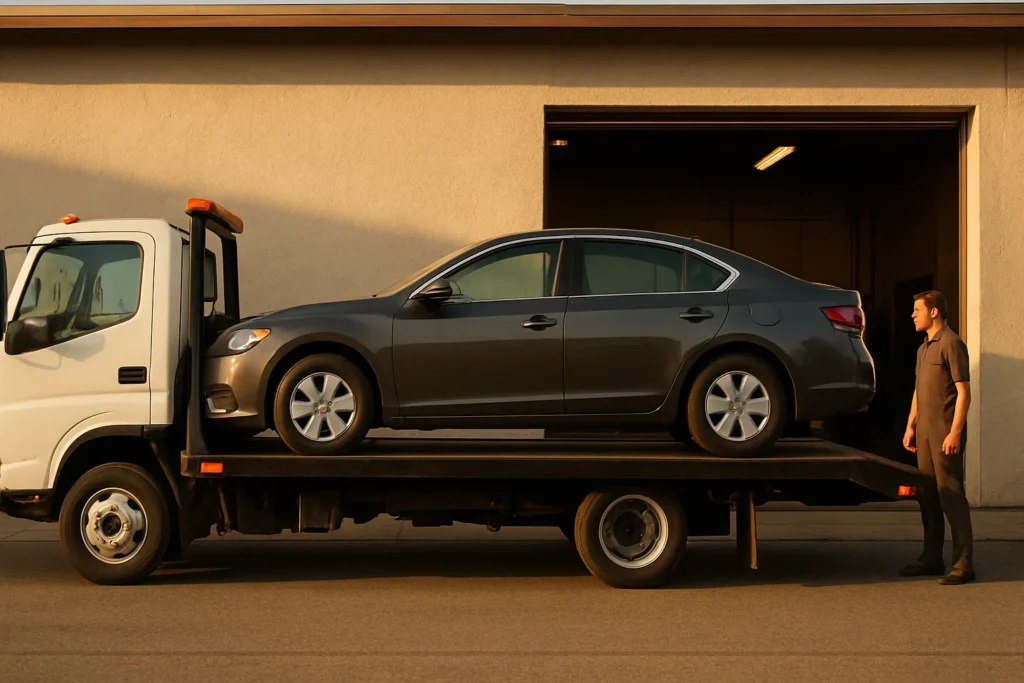
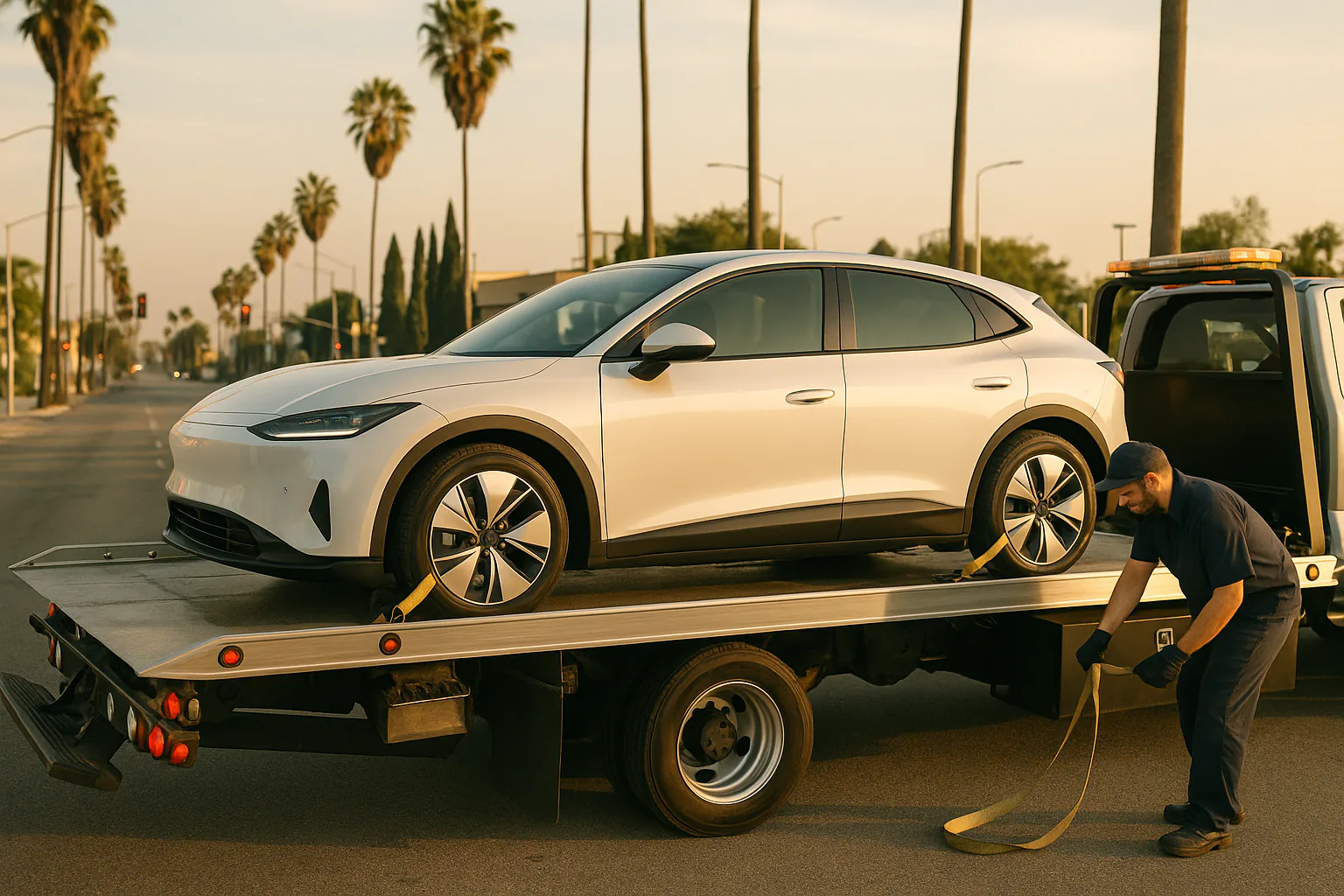
A flatbed carries the complete vehicle off the road. The operator can winch it onto the deck and secure the tires without making the drivetrain turn during transport. Flatbed service is also useful for protecting the underbody battery enclosure and low aerodynamic panels.
Dollies and emergency movement
In tight garages, an operator may use wheel dollies or skates to move the EV into a position where a flatbed can reach it. That is different from towing the vehicle down the road on its drive wheels. The equipment and procedure must match the vehicle’s weight and manufacturer instructions.
Know How Tow Mode and Neutral Work
Many EVs have a transport, tow, car-wash, or neutral mode that releases the parking brake and allows limited rolling for loading. The steps may require the key, touchscreen, brake pedal, or functioning low-voltage system. Some modes cancel automatically when a door opens or power is lost.
Find the instructions before an emergency and keep them available offline. If the screens are dark or the 12-volt system is dead, tell dispatch. The operator may need skates, dollies, an external low-voltage procedure, or model-specific access to the tow eye.
A Depleted High-Voltage Battery Is Not the Only No-Power Problem
An EV can show plenty of driving range and still fail to wake up when its smaller 12-volt battery is discharged. That battery powers computers, locks, screens, and the contactors that connect the high-voltage pack. A trained roadside technician may be able to restore low-voltage power long enough to diagnose or load the vehicle.
If the main battery is simply out of charge, the practical solution depends on location and vehicle support. A tow to a compatible charger is often more predictable than waiting for mobile charging. Confirm that the destination charger works with the vehicle and is accessible when you arrive.
Collision-Damaged EVs Need Extra Caution
After a crash, do not touch exposed orange cables, a damaged battery enclosure, or leaking material. Move away and call 911 if there is fire, smoke, unusual heat, popping sounds, or a sharp chemical odor. Tell emergency responders and the tow dispatcher that the vehicle is electric.
Battery damage is not always visible. The operator needs to know where the impact occurred, whether airbags deployed, and whether the underside struck an object. A damaged EV may need a destination equipped to evaluate high-voltage systems and a safe storage plan.
Protect the Battery Pack During Loading
EVs are often heavy for their size, and many carry the battery in a broad enclosure under the passenger floor. Operators should use approved tow points, suitable winching angles, and wheel-based securement where specified. Hooks or lifting equipment should never be placed against the battery case.
Low ground clearance also matters. Ramps and blocks can reduce the loading angle so bumpers and underbody panels clear the deck. Mention lowered suspension, a flat tire, locked wheel, or underbody damage during dispatch.
Information to Give the Towing Company
Provide the exact year and model, pickup location, destination, remaining range, warning messages, and whether the vehicle powers on. Say whether the key is present, the charging cable is connected, wheels or suspension are damaged, and the parking brake will release. If the EV is inside a garage, provide the clearance height and describe the access route.
Remove personal items and bring the key card, fob, charging adapters, and any wheel-lock key. If the vehicle is going to a service center, confirm its after-hours drop procedure.
Arrange EV Towing in Los Angeles
Maps Towing provides careful flatbed transport across Greater Los Angeles from Van Nuys and Burbank. If your EV is disabled, damaged, or out of usable charge, call (818) 797-1560. Give dispatch the exact model and condition so we can plan the safest loading method.
Share: